Narrowly Defined Grief

I think we have too narrow a definition of when we are “allowed” to grieve.

The morning after the election, my Mom sent me a text asking “how are you doing?” I wrote back that I was “Only ok I think. I’m grieving.” I was not being dramatic, that was really the best description.

Grief isn’t just for when a loved one dies (which sometimes seems like the only “acceptable” time to use that word). It is a personal emotional response to loss. So, you can grieve the loss of a society you thought was coming, you can grieve the loss of a pet or the selling of your childhood home. There is no big or small grief, only personal ones

I think it is important that we open up our definition of grief. I was talking with a friend who was coming to terms with not having any more children. She has a lovely, healthy, happy family…but part of her always saw herself with more kids. She was trying to brush off her feelings but I told her she should give herself permission to grieve. It doesn’t discount how happy she is with what she has, it just acknowledges that there is a loss she is adjusting to.

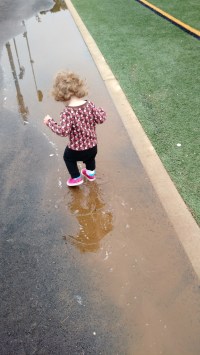
It is also important to accept that young children feel grief, but in different ways then adults do. It is our job to help them weather and recover from losses…it is not our job to rate for them which losses are “important” or when they are “fine” and should “get over it.”

Sometimes with our wider adult view of the world we trivialize the things that young children are feeling. They aren’t used to the big emotions that swamp them suddenly. Their worldview is different then ours, closer to home and much more personal. They won’t react the way we think they “should” but that doesn’t make it wrong.

Moving forward, I hope you give yourself permission to feel loss in all of its forms. You aren’t wrong for feeling true grief, even if it doesn’t feel like something you “should” be “so upset” about.

And please, extend the same compassion to the children in your life. By all means, teach them how to deal with the big emotions they feel…but make sure to teach them it is ok to feel them.


Posted in Early Childhood Education | Tagged , , , , | Leave a comment

I am a superhero…I can

wp-1478807981073.jpg

The morning after the election I sat in circle facing my wiggly, wonderful group of 3 and 4 year olds. It was the first time I’d brought a script with me to meeting. I didn’t trust myself to get through what I wanted to say and I didn’t want to leave anything out.

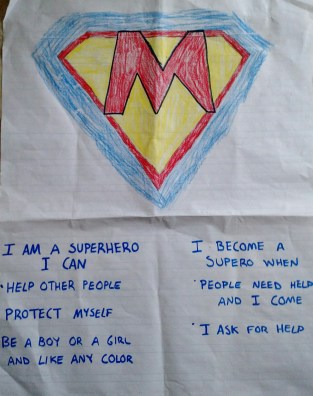
First, I pulled out our superhero poster. They’d worked hard on coming up with all of the things a superhero does and how they can be superheroes. It was our way of talking about being kind to each other, whether you were “best friends” or not. Together we read

I am a superhero, I can:

  • Help other people
  • Protect myself
  • Be a boy or a girl and like any color

I become a superhero when :

  • People need help and I come
  • I ask for help

Then I told them I had something VERY important to tell them about superheroes.

“Did you know that we are all superheroes?

“As superheroes we have a really important job, more important then getting the “bad guy,” do you know what it is? It is protecting and helping each other

We are team together. It doesn’t matter if we look the same, like to play the same things or are best friends. We are a team

If ANYONE tries to make you feel bad, or tell you to make others feel bad, say “NO! We are a team!”

We’ll repeat this. Over and over again we’ll read our list. It is one conversation out of many…but it is a start.

Posted in Early Childhood Education, Uncategorized | Tagged , , , , , | Leave a comment

I Promise

wp-1466099838684.jpgThis is not an overtly political blog. However, if you piece together my demographics and the things I care about (early childhood education, museums, arts, culture, access…) you can make a pretty good guess what way I lean politically.

Which might explain why I am up at 4:30am on the day after the election with anxiety coursing through my body. I can’t stay in this head-space though, it doesn’t do anyone any good. So, instead, let me tell you what I promise.

As a teacher, I promise to love the children in my class fiercely and for just who they are. I promise to see them as individuals and find what they need to thrive. I promise to teach them how to resolve conflict, work together, stand up for themselves and others and explore with wonder and joy. I promise to support the families, respect them and connect with them.

As a museum professional, I promise to continue to work for everyone’s stories to be included . I will create, design, educate and advocate so that anyone can feel like they walk into a museum and belong there. I promise to not shy away from difficult dialog and to learn as much as I can to be a respectful and responsible professional.

As a mother, I promise that learning will start at home for my children. They will learn to think for themselves, they will learn about consent, they will learn about standing up for themselves and others. I promise that I will do everything I can to raise kind kids. I promise that I won’t shy away from the hard conversations.

As a person, I promise that I will be kind. It isn’t much, but it is the best I can do. I will stand up for you, I will smile at you, I will see you for who you are. I will educate myself and use the privilege I have to make whatever difference I can.

This is all I can offer at this moment. No matter what you hear or read in the coming days, remember that there are many people like me who will do what they can, with what they have to care for you.

Posted in Cabinet of Curiosities-Updates, Early Childhood Education | Tagged , , , , , , , | 1 Comment

Vote

That’s really all I have to say today. Go vote, please.

Working as a docent at the Belmont-Paul Women’s National Equality Monument gave me a new appreciation for that right. There are women at the polls today who have been alive longer then their right to vote.

Thank you

Posted in Uncategorized | Leave a comment

Kindergarten Readiness: The Inside Scoop

Before I started back in the classroom I took my friend out to lunch. She is a Kindergarten teacher in a public school and I wanted to get the “inside scoop” on what Kindergarten teachers were REALLY hoping that kids would walk in the front door knowing.

She walked me through all of the district expectations, what they would be assessing in literacy and math and language. “But” she said “None of that really matters. What they need to have are the social skills.”

Yes, you heard it right from the source. Whether your child can read or count is secondary to their social readiness for school. It makes sense if you think about it. The teachers have the academic stuff down, but it is much more difficult for them to teach 20+ kids how to behave in a group, how to walk in a line, bathroom etiquette and put on their coats.

If you have a child who is INTERESTED in the academics, I would never stop you from exploring it with them. But, of higher importance is helping them be ready for the classroom environment, being able to follow the teacher’s directions and how to interact with friends. That is going to be their real test.

Still not sure what social skills readiness looks like? Luckily, NAEYC has a short article that outlines some indicators:

  • listening to others and taking appropriate turns for expressing ideas and questions;
  • handing materials respectfully and putting them away;
  • sustaining engagement with an activity or process;
  • identifying and pursuing his own interests, choosing materials and having some ideas about how to engage with them productively;
  • being safe in relation to the group (staying within school bounds) and attending to personal needs (washing hands); and
  • asking for help when he needs it. (From “Is My Child Ready for Kindergarten“)
Posted in Early Childhood Education | Tagged , , , , , | Leave a comment

Preschoolers and “Weapon Play”

A block, a stick, a paintbrush…preschoolers are an inventive bunch and can turn almost anything into a weapon.

“Look! Our firetruck has plenty of bombs on it!”

“Bang! I shoot-ed you!”

“Let’s get those bad guys!”

I am a complete loss for how to redirect this kind of play in the classroom. Superheroes, that I feel comfortable with, since there is a narrative that you can tease out of helping others and working together. It is when it is straight up “I’ve got a gun” type play that I’m caught off guard.

I know it is useless to “ban” this type of play. So far I’ve talked about how we don’t use weapons at school, asked them what they are building with the blocks (knowing full well they are using them as guns but trying to spark conversation) and also answered their questions about WHY no guns at school honestly by saying that it scares some of the other kids when they play that way.

Usually I try to make these posts somehow helpful to other people, but I can’t even pretend to have an answer…so I am looking for yours!

Posted in Early Childhood Education | Tagged , , , , , | 2 Comments

“Hands On” Art

wp-1476210266787.jpgThe first child picked up the brush and dunked it in the paint. As the paint dripped off onto her hand she ran the brush back and forth spreading a thick coat all over her hand and arm. She was totally absorbed in the feeling of it on her skin and how it looked as she moved the brush through the paint. When her hand was coated she gave the paper a SPLAT, creating a handprint, before going back to covering her hand with more paint.

The second child looked on warily. “I don’t want to touch the paint like that!” He said in a worried tone. I reassured him that he could paint however he wanted and showed him all of the brushes we had available. He carefully dipped the brush in the paint and worked steadily to cover his whole paper in color.

In the end, both papers were full of swirled color, but the hands of the two children couldn’t have looked more different. It was a perfect snapshot of how individual kids are in their approach to sensory (or “hands on”) experiences and why it is so important to have a variety of ways that they can get involved.

If I had asked the first child to paint just the paper, she might have slapped some color around but probably wouldn’t have been absorbed as she was. If I had told the second child he had to get his hands dirty he probably would have avoided painting at all. Instead, by letting them approach it their own way they both were able to experience the texture of the paint and the way the colors mixed and what happened with different brushstrokes.

As your planning experiences, in the classroom or the museum, look at how you can respect the different needs that kids have for (quite literally) diving in with both hands. It can make quite a difference

Save

Posted in Early Childhood Education, Museum Education | Tagged , , , , , , , | Leave a comment

Setting Expectations


“Setting expectations” is part of classroom management 101. What they mean is, getting the kids comfortable with the routines and with how they are supposed to behave at various points in the day. What I think is often left out is setting your OWN expectations.

I started the year with grand plans. I was so excited to be back in the classroom and was full of ideas of the things we could explore together. I thought once we got comfortable with our “meeting time” routine was could jump right in. Well, after about a week I realized my expectations weren’t calibrated correctly. My class was bright, enthusiastic, happy to be at school…and needed more time to get used to how meeting time worked.

I spent one day beating myself up that I was doing something “wrong” because circle time wasn’t running smoothly. Then I watched them figuring things out, waiting to hear what their friend said before they spoke up, raising their hand, able to sit next to a friend without getting too distracted. It made me realize that our learning was happening in a big way, it just looked “ordinary” because we were figuring out how to be a class together.

I think early learning AND museum educators see all the wonderful potential for the kids in their programs and the collections they have at their fingertips and get a little greedy. They want to do it all right away. It’s important to remember that success isn’t measured by the vocabulary word that the kids can rattle off, or how many paintings they’ve seen. Every moment spent getting in the groove of the day, getting comfortable with routines and learning to be with others is time well spent.

Posted in Early Childhood Education, Museum Education | Tagged , , , , , , | Leave a comment

Project Confidence

2016-10-01-17-22-00

On the playground the other day, one of the kids came running up “I’m afraid of ants!” she said “They are scary!” Without missing a beat, my co-worker jumped in to the conversation “Oh really?” She said “I think they are so cool!” She pointed out all the things that they were doing and finished off by saying “Besides, think how scary WE must be to THEM! We are so much bigger then they are!” In a much sunnier mood, the child ran off to play.

About ten minutes later she ran back up to us “Look at this!” She said with great enthusiasm. In the palm of her hand was a giant, dead, cicada. “Wow!” we agreed “Look at that!” She then organized a group of kids to collect all of the cicadas they could find for the science table.

That is the power of projecting confidence. Whether it is about things that you find creepy-crawly, or even your kids starting a new school, they read so much from your emotions. If you can project confidence in what is going on they will model that.

Posted in Early Childhood Education, Uncategorized | Leave a comment

The Gift of Time

wp-1475285310549.jpgYoung children can do amazing things when they have the time. You’ll read article after article talking about how we over schedule our kids and we need to slow down and simplify. However, I think it goes even farther then that. We don’t just need to simplify, we need to give them the blocks of uninterrupted time to let their ideas unfurl.

I am very lucky to now be working at a “learning through play” preschool. Our whole day is built around giving them large chunks of time to play, and the materials to do it. In just three short weeks I’ve seen how this “gift of time” is leading to more and more complex ideas and cooperation.

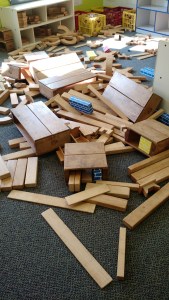
Take the block area. The picture above is from the first day…and it was quite a mess. They delighted in pulling out every block (it was new to many of them), building structures as tall as they could and then crashing them down.  It was glorious fun, but it was pretty one dimensional.

wp-1475285207194.jpg

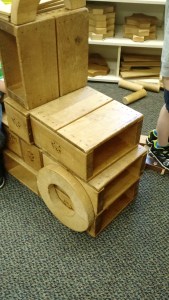
Now here we are in week three. The same groups of kids are coming back to the blocks time after time. Instead of just fighting to get the choice materials they are banding together to make more and more complicated structures. This picture is of the fire truck they built, with enough seats stretching out behind for four or five kids.

I think that often we adults think that if kids have the same things to play with day after day that they’ll get bored. Maybe that is true with “uni tasker” toys (an Alton Brown phrase for something that only does ONE thing). But, with open-ended toys time can actually make the play more involved and they can get MORE engaged…rather then bored.

Does your space have room for kids to explore? Do they have access to materials? Most importantly, do they have time to do it?

Save

Posted in Early Childhood Education, Uncategorized | Tagged , , , , , , , | Leave a comment