Purposeful Mess

Purposeful Mess“So, how do you feel about mess?”

It’s a question I pose during my workshops on STEM (Science, Technology, Engineering and Math) for early childhood educators. I love it because you get an immediate visual reaction from everyone.  Some of them pump their fists and say “I love it!” Others shift a little uncomfortably in their chair and some fold their arms almost as if they are protecting themselves from the idea.

It isn’t as if any of these educators expect children to not make a mess. There are just a lot of factors at play. Some may not have enough help in the classroom to make facilitating messy play easy, administrators may hold them to high standards of classroom organization or they may have families who don’t want (or can’t afford) for their children’s clothes to get messy.

When we probe a little further, they start to explain. “I don’t mind mess as long as it is FOR something.” or “When they are learning and it gets messy that is fine.” What they usually land on is the term “Purposeful Mess” and most agree that mess with a purpose is a key part of early learning.

This is important to think about because learning is messy. Young children need to get in there and try things out and experiment and see what happens. Mess takes many forms. It may be dirt and mud and sand but it can also mean art projects that aren’t recognizable or discussions that veer from the lesson plan.

“Purposeful Mess” doesn’t mean letting them abuse materials or abandon responsibility for cleaning up after themselves. It also doesn’t mean letting them totally run the show. What it does mean is being willing to let them get in there with both hands and try things out for themselves and being ok with things going “off script” sometimes. “Purposeful Mess” is often where some really amazing learning happens.
Posted in Early Childhood Education | Tagged , , , , , , , | Leave a comment

Creating Wild Places

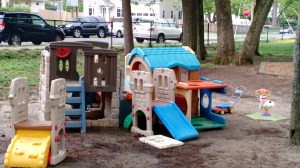
img_20160503_162539469.jpgBaby slides, push toys, ride along cars. In our town, when they are outgrown and unwanted they find there way to this one park. Since they don’t “belong” to anyone, no one is worried about keeping them “nice.” That means that the kids can use them in every creative way they want. Every time we come they’ve been pushed into new positions,m filled up with sand or tipped on their side. You can see the potential and imagine the elaborate play schemes created on them.

At the end of every workshop on science or play, I urge the educators to make sure to get their kids out in nature. There are plenty of studies showing that we don’t go there enough, and that children are “nature deficient.”

But educators may look around at what they have to offer, and feel like it isn’t enough. Maybe they are in a very urban area, maybe they have a hard-packed playground with adult-chosen equipment.

Luckily, as this picture shows, that doesn’t matter. It doesn’t matter what is in the space as much as giving kids the time and freedom to explore and create. Whether you have an award winning “nature playground” or hard-top and a fenced in tree, get them out there and let them play.

Posted in Early Childhood Education | Tagged , , , , , | Leave a comment

Museums and Schools: Common Ground

MuseumsandClassroomsI led a workshop last weekend called “Everyday Museums: Re-imagining Classroom and Community Spaces.” It is a fancy title, but basically what I try to do is get early childhood educators to think of their classrooms as museums. This isn’t in a “Do Not Touch” kind of way, but instead taking inspiration from the way that museums put objects at the center of their learning.

It may seem like a bit of a stretch at first, after all what do a toddler classroom and an art museum have in common? So, we brainstorm. In the photo above you can see all of the words that come to mind when you think of “Museum.” Words like contemplation, art, guides, quiet, learning and, yes, even boring fill the page.

Then I ask them to have me circle any words that ALSO apply to their classroom. You can see that, with only a few exceptions, most of the words overlap.

Remember that if you ever think that the things you learn in (and from) museums can’t apply to your classroom…or that the things that work in a classroom have no place in the museum.

Posted in Cabinet of Curiosities-Updates, Early Childhood Education, Kids in Museums, Museum Education | Tagged , , , , , , , | Leave a comment

Who Is On Your Exhibit Team?

img_20160406_202913027.jpgI recently asked a group of Museum Studies grad students a deceptively tricky question. “What is your #1 priority for an exhibit?” Not a whole museum, just a single exhibit. It could be big (connected ideas) or specific (enough benches)but they had to pick something that could make or break an exhibit experience for them. Although some of the answers connected, they each had a unique something that they looked for in an exhibit.

Then, we turned the conversation outward. I asked them to help me brainstorm a list of anyone who might have a stake in, or feel some ownership about, an exhibit at a museum. Once again, not an entire museum…just a single exhibit. The list kept growing and growing. “Visitors” was broken down into different generational categories, families, school groups, members, donors, researchers and one time visitors. Social media, events, the community at large, sponsors, board, volunteers soon took over another part of the board. Staff, art handlers, other museums and security and more filled in the rest of the space.

Once we’d run out of ideas for who would feel connected to the exhibit, I asked them to think back to their “one important aspect” and to imagine what the #1 priority for each of these groups would be. Amenities, experience, access, exposure, safety, the objects…the list grew and grew with some groups overlapping but most having a unique need.

Our final task was to match each of these needs with someone in the museum who could address them. Curators, education, visitor services, security, maintenance, events/PR, development, exhibit design, registrars…each group had at least one and in many cases multiple staff that would best be able to handle their needs or anticipate problems that might come up.

So…who is on your exhibit team? Without the objects and the aesthetics you won’t have an exhibit, but without the voices of other people in your museum during the planning process you won’t have a SUCCESSFUL exhibit. Including front line staff, education, maintenance, marketing and others in the initial conversation will help you have a stronger exhibit that not only meets your mission, but reaches the groups that are your museum’s stakeholders.


Posted in Museum Education | Tagged , , , , , | Leave a comment

STEM in Early Childhood- Professions

wp-1456062061377.jpgLucyAceMaggie 010wp-1456062075158.jpg

One of my most popular workshops recently is one simply titled “STEM in Early Childhood Education.” STEM (Science, Technology, Engineering and Math) is a hot buzzword right now, and educators are pressured to show how they are teaching it and using it in their classrooms.

For people who work with babies, toddlers, twos and preschoolers this can feel pretty daunting. Sure, a baking soda/vinegar volcano has a “wow” factor, but does it go beyond that? Do they REALLY get the concept of chemical reactions?

I try to bring STEM back to the basics and show educators how it really is woven into the whole day, it is just up to you to tease it out and highlight that for your kids. In the middle of the session, I’ll stop and take out a big piece of chart paper. Across the top I write “STEM JOBS” and ask them to start lobbing out ideas. We quickly run through doctor, vet, accountant, architect and with each one I say “That’s great, what else?”

As I keep pushing the ideas get more creative…plumber, cashier, gardener. With a little hesitation someone asked about theater and we ran through lighting design, set creator and more. They start building confidence and start throwing out jobs from all corners of the economy.

At some point I see someone pause, look at the list and get a thoughtful look on their face. “Um, well, what it seems to me is that almost every job has STEM in it.” Yes! You are right! In fact, the challenge is to find a profession that does not use some component of STEM instead of the other way around.

Looking at things this way turns on its head the idea that STEM jobs only exist in elite fields, using laboratories or space age technology. Now, it is approachable to look at how kids can play and explore in the classroom using this as a starting point. Construction tools with rulers and levels in the block area become math investigations, add PVC pipes to the water table and plumbers create engineering marvels. Botanists and animal enthusiasts thrive in outdoor play areas and artists use their knowledge of the human form, and what they need for structural integrity, to sculpt out of playdough.

Using STEM jobs as a way to structure classroom exploration lets you play to your strengths, and the interests of the children, while still bringing in new elements. It is also easier to see how STEM can move beyond the designated “science area” and into the rest of the classroom. It keeps things focused on building foundations of STEM, instead of worrying about how fancy it looks.

Looking at STEM jobs also encourages educators to look at their community resources. Many families have a parent or caregiver in a STEM job and they can add expertise to your explorations, and also give the children a sense of pride in what their family does.

Many early childhood educators will say they don’t “get” science or that they aren’t “good at it.” In truth, they are doing it throughout the day, every day. It sometimes just takes looking at it from a new angle for them to see that and get re-inspired.

Posted in Early Childhood Education, Museum Fun at Home, Uncategorized | Tagged , , , , , , , , | Leave a comment

Aquarium Visit Reboot

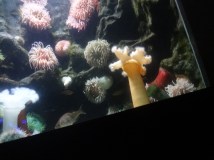
AquariumMarch 042The last time we visited the National Aquarium, my son (3yrs old) treated it like a race he had to complete. I don’t know if it was the fact there was a “path” to follow, the crowds or what but I couldn’t convince him to slow down and look in the tanks. He just bee-lined straight from the “beginning” to the “end” as quickly as he could. I never consider a museum visit a waste…but I will say we didn’t get QUITE as much out of this one as we could have.

When a fascination with the show “Octanauts” led to him reading any ocean animal books he could get his hands on and asking for more and more facts about undersea creatures, it seemed right to try the Aquarium again. This time, I decided to experiment with ways to help us slow down and look.

Going in we had two big points in our favor

  1. He was really really REALLY into ocean animals.
  2. We could go on a weekday morning when I knew the crowds were going to be lower.

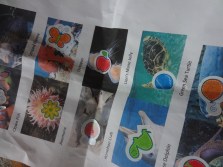
The night before I went on the Aquarium website and picked a handful of animals that were on display. I copied and pasted their pictures into a Word document (super high tech I know) and created a make-shift “Bingo” sheet. AquariumMarch 063

In the car on the way there I gave him the sheet to look at and told him we were going to try to find all the animals and when he found one he could put a sticker on the picture. (The stickers stayed safely in my bag until he needed one to put on…I didn’t want any straying and ending up on museum walls!)

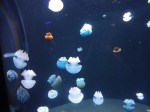
I could tell he was excited, he had that competitive gleam in his eyes and was rattling off everything he knew about the animals I’d listed. When we got there, I steered us away from the main path through the Aquarium and to the special exhibit on jellyfish. He had a special fascination with “jellies”so I knew he’d like, and I also hoped it would give us good practice looking before we got on the main path.

One other important piece of prep work I’d done was giving myself a stern talking to. It didn’t matter if the bingo sheet worked, if we were only there for 30min and if he only looked at one thing. We were just here to enjoy it at his pace and that was THAT.

Well…it worked. It worked so well even I was caught off guard. At first he was laser focused on finding the animals on his sheet, but that meant he had to look in each tank. Doing that meant he found other animals he knew from the show or his books or just things that looked cool.

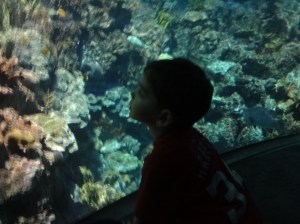
AquariumMarch 038I also let him wield the camera and snap pictures of whatever interested him, which made him pause and look just a little longer. When he couldn’t find the last animal on his sheet he asked museum volunteers for help and learned new facts in the process.


I let him take the lead, the only time I stepped in was when he was drawn in by the computer touch screens. I let him look for a while but then I moved us along. He would have stayed all day punching through different animal facts…which is great but also an experience I can give him outside the Aquarium walls.

After 2 hours I finally had to call a halt. Baby sister started to lose it and the rest of us were getting hungry. He would have stayed longer, but I also think that he would have gotten hungry and tired and things would have fallen apart quickly. Instead, we left on a high note with him practically skipping out holding his completed sheet.

So, what worked this time?

  • I tempered my expectations so I would (hopefully) not be disappointed no matter what
  • We jumped on a current interest and structured the visit around that
  • I leveraged his love of “achieving” with a bingo sheet full of manageable goals
  • I looked for ways to make us pause and look (camera, looking for specific animals, starting in a small exhibit)
  • We went at a good day/time both for us and the crowds.

It isn’t a fail proof method, but it gives me a hazy outline to use for future museum visits. Hopefully one you can adapt for yourself!

AquariumMarch 059 AquariumMarch 025 AquariumMarch 024


Posted in Blog, Kids in Museums | Tagged , , , , , , | Leave a comment

Just Not Her Thing?

NewComputerPictureOffload 424wp-1457871987008.jpg

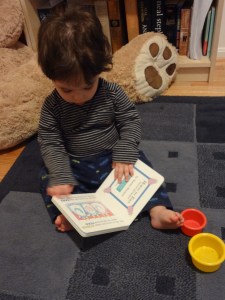
When my son was little, it became obvious very quickly that books were one of his favorite things. As soon as he could sit and coordinate his hands he would flip through pages on his own, and he would bring book after book for us to read aloud.

My daughter? Not so much. Oh, she loves books, but mostly to bang on and turn upside down and try to chew on. If her brother reads to her, she loves to listen, but with us she mostly turns her attention to pulling other books off the shelf.

Both my husband and I started to think of books and reading as “not her thing yet.” We keep books in the play area, and read to her when she seemed like she’d listen, but it wasn’t as much of a “go to” as it was for our son.

Then, I picked up a lullaby book that had photographs of babies in it. She was riveted. She kept patting the babies and babbling excitedly. So, at the bookstore I scoured the shelves for any other books with real babies in them (I could only find two). Last night, we read those books over and over and she focused on them for a good 15-20 minutes.

So, I was wrong. It wasn’t that reading “wasn’t her thing,” it was that I hadn’t explored far enough to see what she needed. An important reminder for me as a parent and teacher.

**UPDATE: My son gave me another good reminder to explore further before writing something off as “not their thing.” He is rarely interested in drawing at home and doesn’t gravitate towards the art table at school. However, he recently has been on an ocean kick and got inspired to draw some of his favorite animals. My fridge is quickly filling up with all of his drawings inspired by something he is passionate about!**

Posted in Early Childhood Education | Tagged , , , , , , | Leave a comment

What do YOU think?

wp-1456064442102.jpg

“Look Mama, the water is going down the drain”

“Oh yeah, you are making a channel for the water”

“What is a channel?”

“What do you think it is?”

“Hm, it is like a long conveyor belt for water!”

And there you have the best reason I can give you for asking questions and waiting for the answer.

Posted in Early Childhood Education, Uncategorized | Tagged , , , , , | Leave a comment

STEAM in Action

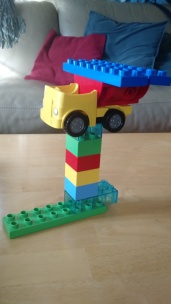
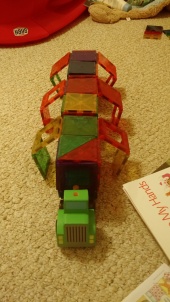
“Mama look!” My son called to my excitedly “I built a truck with stabilizers!” Sure enough, out of his magnet blocks he had constructed a perfect replica of a truck he had seen on a favorite TV show. “Those help it not tip over!” He told me.

The next day I heard the crash of Duplos falling and a frustrated roar from the living room. Then, silence. I peeked in and saw him concentrating hard on something. When he was finished he stepped back with satisfaction. “Mama. Look at my sculpture! It was falling over but then I put a stabilizer on it…just like my truck”

STEAM (Science, Technology, Engineering, Art and Math) is sometimes brushed off as an attempt by “the arts” to muscle in on the popularity of STEM. I think that it is more then that. When you remember the role that STEM can play in the arts, and how the arts can influence people who are engaged in STEM, you see how important it is to link them together.


Posted in Early Childhood Education, Museum Fun at Home, Uncategorized | Tagged , , , , , , | Leave a comment

But When Will They WRITE?!?

wp-1456062326563.jpg

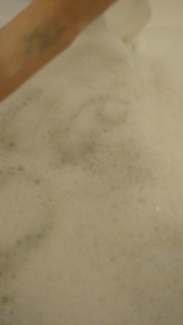
The picture is a little blurry, but let me see if I can “set the scene” for you. In the bath the other night my 3.5 year old was playing with a squirt bottle. “LOOK Mama!” He shouted excitedly “I made an O! What letter should I make next?”For the next twenty minutes he attempted letter after letter, squirting water into the bubbles to make the shape.

It may not be particularly noteworthy to most, but since this is a kid who never goes near the art center (unless, as he told me with a sigh, “Teacher said we ALL had to try it today”) and loves books but brushes off the idea of writing. I was excited to see HIM excited about letters and writing.

It was also a good reminder that it-will-happen. At this age what they need from us is a chance to get excited about reading and writing.

It is totally ok to read book after book about their favorite subject (that would be cars and trucks in our house). There is nothing wrong with graphic novels and picture-heavy books, in fact they are an awesome way to get kids decoding what is going on in the story.

Writing can be making shapes in playdough (it strengthens their hands for pencil-use later), brushing water onto the fence with a paintbrush or smearing around shaving cream.

There is no reason to try and force them to read what you think they “should” or write if they aren’t ready.  They are absorbing so much from what is around them like stop signs as you drive and a recipe as they “help” make dinner. Most importantly, they are learning that reading and writing are fun, and a way to be together and spend time with you. That is the most important lesson.

Posted in Early Childhood Education, Uncategorized | Tagged , , , , , , , | Leave a comment