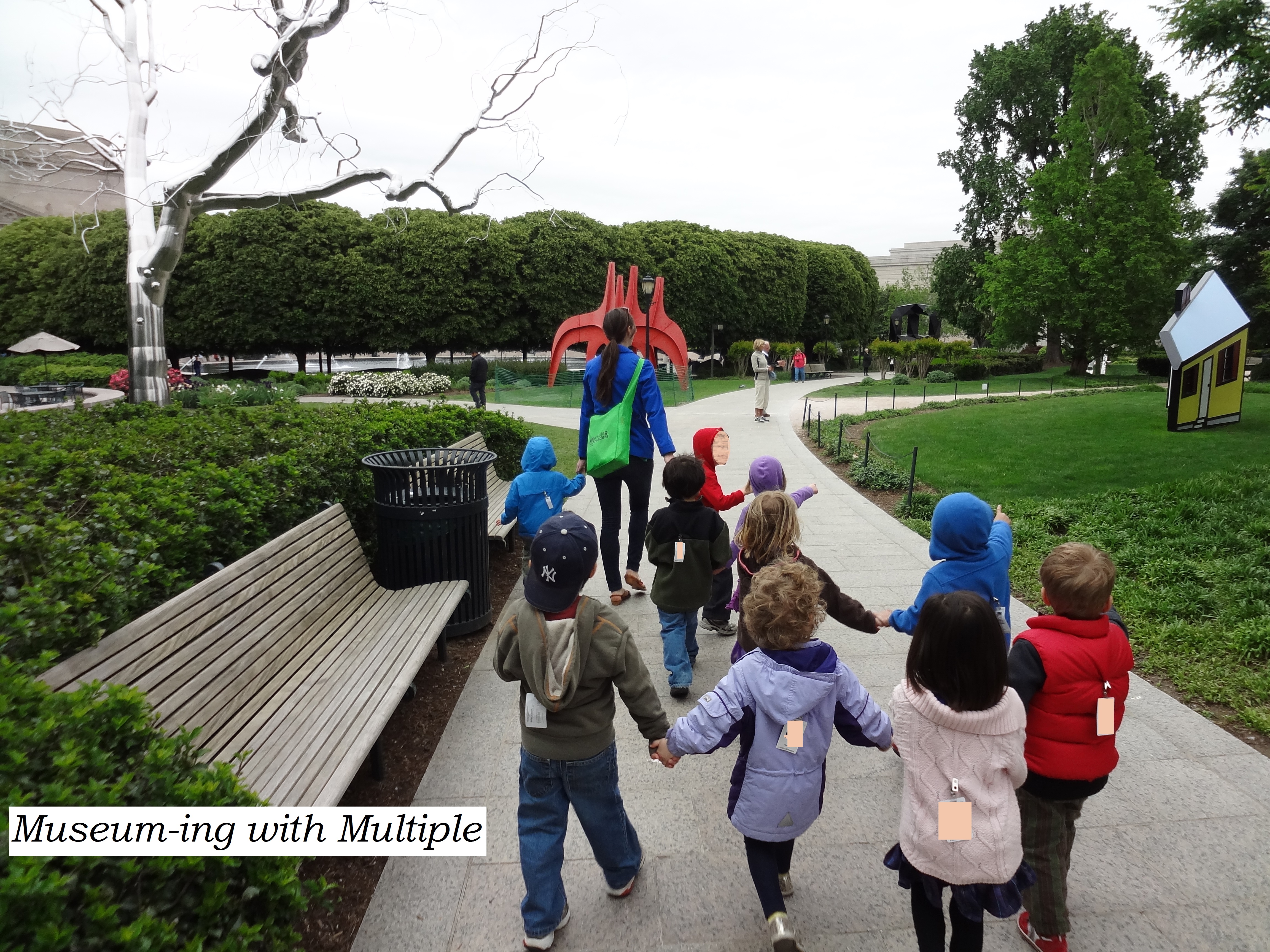
Museum-ing with Multiple

Museuming with Multiple. Tips for visiting with multiple kids and kids of different agesRight now when I got to the museum, I’ve still got a one-to-one ratio.  One son + one parent = odds pretty well in my favor. If it is a weekend and my husband is with me, that is a luxurious two adults to one child!

I’m not saying this to gloat (or “humblebrag” as I’ve seen it put).  I’m acknowledging how lucky I am in my current museum wanderings. At a recent presentation a Mom asked me how many kids I had.  When I said one she sighed and said “Oh, only one, well that’s why you can go to a museum.”  I realized that, for some people, they felt like what I was saying was less valid because I didn’t have a more kids then hands to hold them with.

So, let me give you a little background.  Before my son was born I was a preschool teacher at the Smithsonian Early Enrichment Center. In my last year teaching, my co-teacher and I would take 13 three year olds into the museum on an almost daily basis.  Essentially, it was like I was a parent to…well…the internet only goes up to 9 (nonuplets)but a lot!

I promise, I get it, when you add in extra kids (and especially kids of different ages) everything gets a lot harder. I really hope that it won’t stop you from visiting museums. It just means that your planning has to be a little different.  Here are three “survival tips” that I honed during my years teaching.

1. Have an Escape Hatch

When we would go into a museum for a circle time, I would always have a few layers of my lesson plan.  Layer A was the baseline concept I wanted the kids to grasp.  If that went well, I had layers B and C that I could expand on.  The key though, was making A something approachable, short, and easy to accomplish.  That way, if we needed to bail it was alright.

Going with your own kids is similar.  Plan the ONE thing you want to see that day.  Make sure you are at peace with the idea that you might go all the way there, see that one thing, and then have to leave.  But, have items B and C on your list in case things are going great! I guess you could call this “plan for the worst, hope for the best”

2. Cater to the Common Interest

It makes sense to find things that all of your kids (and the adults) will like.  I would bet that is part of the reason why Natural History and Air and Space are so popular! But, we all know that it isn’t always possible.  After all, Natural History is great….the first dozen times…but then you might want to branch out.

So, if you can’t find an exhibit that meets everyone’s needs, you have to look for other ways to find common interest. If the exhibit speaks to your younger child, get the older one to become an exhibit critic, or give them the camera and put them in charge of documenting the visit. Ask them to read up on what you are looking at so they can teach the rest of you something.

When it is your older child who is engaged, get the younger one to do an “I Spy” through the space looking for shapes, letters or colors.  You can also sketch, use your body to act out what you see or bring a book and read off to one side.  If you are my son, all you’ll need is a matchbox car and a flat surface to stay occupied!

3. Meet the Basic Needs First

One Mom I talked to said she always gets to a museum early so her kids can burn off energy running around outside.  That is an awesome idea. We are all tuned in to how our kids react when they are hungry or tired, but think about the other basic needs your kids might have.  Maybe they need to have a break away from crowds, or to give out a yell and run around.  You can accommodate those things in the museum, it just may take a little looking. There are often outside spaces where they can run and staff can point you to less used galleries. Don’t hesitate to ask the museum staff to help you find what you need, they want you to enjoy your visit.

Another part of this is a child’s basic need to understand what is happening and have some boundaries. It might be really rough the first few times you go, maybe even the first dozen times you go.  But, as you reinforce the rules and they can practice how to behave it will get easier.  Think of it like the library, if you feel comfortable there you can feel comfortable in a museum!

I understand if you don’t feel like going to the museum too often.  With more kids then adults it can be tiring..  I hope though that you will still try it.  Just every once in a while.
 

Posted in Kids in Museums | Tagged , , , , , , , | Leave a comment

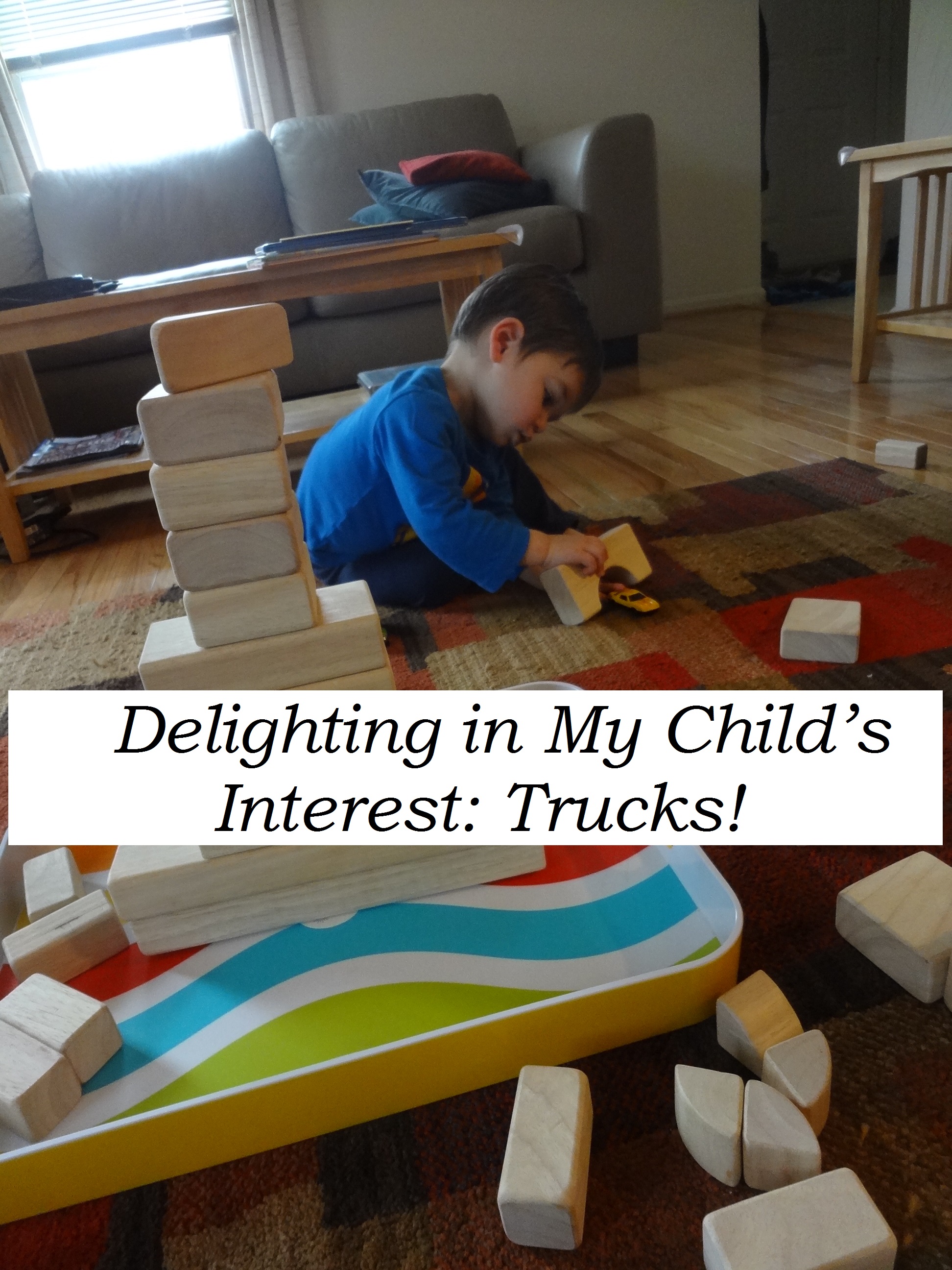
Delighting in My Child’s Interest: Trucks!

So what if my child only wants to play with trucks. There is so much we can explore with them!My son loves cars, trucks and all things that go.  I know a lot of Moms might say that…but in our house that is the main toy of interest at all times. At first, I was a little worried about that, and wondered if maybe I should try to “force” him to play with something else (because we know with toddlers that ALWAYS works..right?). Then, I started thinking about all the ways I can guide him to explore new things by incorporating and encouraging his car play.

Those thoughts turned into a new post for NAEYC’s “For Families” site…enjoy!

My friend and I have something in common.  Our sons (mine is a year old hers is 18 months) both love trucks!  When we go to the library – what do they want? Books about trucks. When we’re on the street what do they notice? There goes a school bus! A concrete mixer! Wow that truck is fixing a stoplight! Every playdate starts out with an excited “Cars? Trucks?” as they race into the playroom. Cars drive over the sofa, the barn gets repurposed as a garage and long lines of cars march over the piano.  The cars even came out with us to play in the snow and the transportation themed maze puzzle makes long car rides seem shorter.

She and I have both had people ask us why we don’t encourage our sons to play with something else.  One dad even joked, “Try taking all the trucks away one day and see what happens.”… Continue reading here

Posted in Blog, Early Childhood Education, Museum Fun at Home | Tagged , , , , , , , , | Leave a comment

Take a Step Back

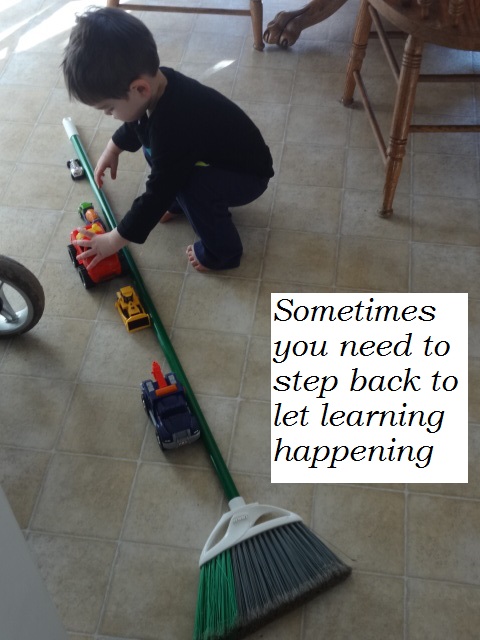
Sometimes learning happens best when you step back and stay out of the wayHave you ever gotten to see a child learning? I mean really seen them go from “no idea” to “AHA!”  I know where we got phrases like “watching the wheels turn” it had to have come from someone watching a baby or toddler explore.

In the last few weeks, I’ve had three moments where I was lucky enough to catch my son’s discovery process from start to finish.

The first was when he asked for the broom.  He carried it over to the dining room and laid it carefully on the ground.  Then, he started bringing in cars and lining them up along the broom.  Each one was positioned with much deliberation and sorted and switched around until things were just right. There was a huge amount of purpose in what he was doing, even if I wasn’t able to quite see what the desired result would be.

The second was when we handed my son a flashlight.  You think cats have fun with a light, try it with a toddler! He started off by shining it directly into his eyes (don’t worry, it wasn’t overly bright).  He moved on to highlighting his feet.  Then, like a cat, he tried to run in circles and catch the light.  Soon, he was using it to illuminate the ceiling, different body parts and testing it out in a darker closet.  By the end of the day, he had invented a game where he had us name different objects and he would run and shine a light on them.

The third was when we were making dinner one night.  He really wanted to help so I pulled out the ingredients for cornbread muffins. Baking is becoming a familiar process for him so he scooped and stirred happily.  I turned my back for a minute and when I looked back he had a spoon full of batter lifted high above the bowl. I started to lunge for it…as he neatly dropped the batter into the muffin tin.  He worked very carefully to transfer batter spoonful by spoonful into the tin (scattering about a ¼ in the process of course) and was very proud that he had done the next step “by self.’

You might have noticed a theme in these three stories is me staying out of the way. Although I was nearby to provide tools and spotting as needed, the exploration was all his own. The time spent digging in and processing is such an important part of how a young child learns and one educators need to plan for.

When you are planning a museum program, make sure you build in time to let the child explore the materials and space on their own.  I know how hard this when you have a message that you feel needs to be shared and so many exciting components to introduce.  Look back over your plan, if you are having to push hard to get the message across…it means the message is too big. Simplify what you want them to come away with, bring it down to the very core message.

Although it can be hard, let go of them finding that message “your way” and trust they will get there.  You can still build in ways for them to show you that learning has happened, just with more leeway for their own exploration.  Also, you can provide materials for their caregivers to build on later that will let you expand what you wanted them to take away.

If you build into your programs time to breathe, kids will be better able to explore, learn and love doing it.  An unexpected benefit, you will be forced to step back and watch…which will give you ideas and show you what you can do differently next time.

Posted in Blog, Early Childhood Education, Museum Education | Leave a comment

Look Don’t Touch

How “interactive” a museum is often how people judge whether it is “kid-friendly” or not. I’d like to challenge that.  Sometimes, even a space where you can’t touch anything can be a totally immersive, interactive experience for kids of all ages.

I have a new post up on American History’s blog “O Say Can You See?” that talks about creating powerful visits involving nothing but observation.

As a mom who works at the museum, I’m often asked for recommendations on what other families should see when they visit the museum. In one of these conversations with a friend whose son is the same age as mine, I immediately recommended America on the Move. I told her it had all the trucks, trains, and cars that her toddler could desire.

“Great,” she said. “Is it interactive?”

My immediate response was, “Oh yeah, it’s super interactive…” and then I stopped. Mentally reviewing the exhibition, I realized that, for the pre-reading crowd, America on the Move actually is not interactive in the typical definition.

There is excellent audio of the objects chugging and whoo-whoo-ing, there is a video of movie clips and the model of the Chicago L that you can “ride” on was a favorite of my pre-school classes and is now where my son beelines when we visit. But beyond that, there’s not much for my toddler to “interact” with in the exhibition.

So, why was my first response to say “yes” that it is an interactive exhibit… Continue reading here

Posted in Blog, Cabinet of Curiosities-Updates, Kids in Museums, Museum Education | Tagged , , , , , , , | Leave a comment

The Fun Doesn’t Have to Stop

The fun doesn't stop when you leave the museum. Creating meaningful pre and post visits for kidsMuseum Educators are constantly thinking about how to get people excited and KEEP them excited the museum. After all, they want you to come back!  Besides having interesting things to do when you are actually there, many educators (especially those working with schools/groups) leverage the “pre-visit” and the “post-visit.”

As it sounds, the “pre visit” happens before you even arrive.  There are activities, logistical information for the adults and things to get you thinking and looking the minute you arrive at the museum. Sometimes, the Museum Educator themselves can come to the school, but other times they send a kit or a “traveling trunk” so the teachers can present it to the class.

A “post visit” is a way for everyone to debrief and extend the learning when you’ve left the museum.  There might be activities that use materials or tools you can’t bring in the museum (like paint) or things to research and ways to turn what you’ve learned into projects.  The hope is, everyone is still buzzing with excitement about what they saw and they want to go further!

Although museums may not offer something as formal for visiting families, you can create the same benefit for yourself!  Your “pre visit” might be as simple as looking up how to get to the museum and planning some of the sites you want to see (if your kids are old enough this is a great activity for them to take part in!).  You could also read some books about the topic or look up information online to give you a head-start.  Talk to your local librarian and they might be able to send you home with a stack of books all about it!

Not only does incorporating a “pre visit” get you excited, it also takes some of the nerves away.  For kids (and adults!) that like to know what to expect, seeing the map and figuring out how you are getting there, where you could eat and what you might see can take some of the anxiety out of visiting a new place.

The “post visit” is where you can really let your imagination run wild.  Maybe now you go to the library and get out books on the subject. Recreate the art styles you saw at home, sculpt with play-dough, use figurines and blocks to build the museum yourself, turn your photos into a scrapbook (physical or digital) and get your kids to narrate what they saw and why it was important. For more ideas, you can visit my Pinterest boards or keep an eye on Facebook

It doesn’t have to be a formal “project” like you would do at school, but any follow-up will help them feel connected and interested in learning more about what they saw. As a bonus, for the kids that might not resonate off of the visit itself they may be more able to get into the messy, creative, aftermath at home.  Training yourself to think about your museum visit in three parts (planning the trip, actually going and how you’ll turn it into play after) will help keep the excitement going long after you’ve left the museum.

Posted in Blog, Museum Fun at Home | Tagged , , , , , , , | Leave a comment

You Don’t Have to Be Quiet in a Museum

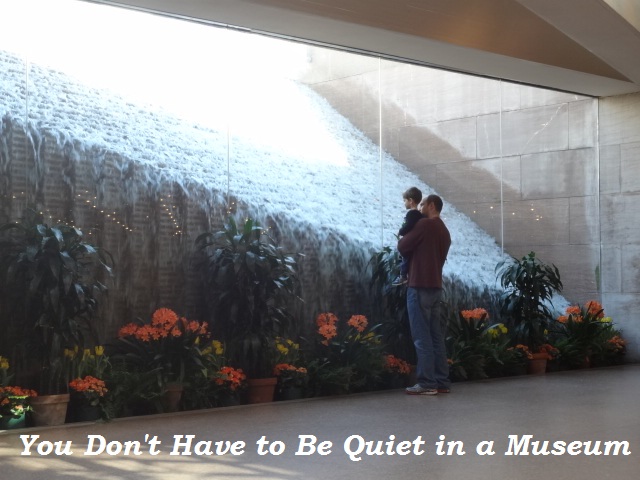
You don't have to be quiet in a museum. Ways to talk, move and enjoy respectfullyThat’s right, I said it…you don’t have to be quiet in a museum. This is one of the most persistent myths I hear about, that museums need the same reverent silence expected in most houses of worship. It isn’t true!

Now, do museums need to be treated with respect? Yes!  Do you need to take into account the experience of others? Absolutely!

In a museum there ARE certain expectations, first and foremost probably being don’t touch the stuff you aren’t supposed to touch.  However, nothing in there says you stay still and silent through the visit.

Talking with each other is one of the best ways to experience a museum.  Ask questions, point out things you notice, giggle at the silly looking portraits, give each other “I Spy” mysteries to unravel. Even my 1 1/2 year old loves to look for “two hats” or “paintings with apples” and finding all of the animals in a room can keep you busy together for a while. If your little one gets a bit too excited and shouts something out, that’s ok.  You can help them learn the “museum voice” they need to have, even if it takes a little practice.

Let them move, within limits.  If you are in a room full of Degas’ portraits of dancers…ask your little dancer to imitate the pose. If there are instruments, ask them what it would look like to play them. With animals you can imitate the posture and walk. Obviously, you know your child and whether they can follow directions to make you feel comfortable doing this. Keep an eye on your surroundings…you don’t want to bump into people or priceless works of art…but if there is the space then use it.

Use media to add to the experience. I love bringing books to read in a quiet corner (they can also become the basis for a scavenger hunt).  Little artists might love to sketch in a notebook (pencil only please, to protect the objects). You could also use digital technology to look up things by the artist, access clips of movies or music to add to what you are seeing. Take pictures (if it is allowed), better still let your KIDS take pictures and make them tell you why they wanted that particular shot. As long as you aren’t disturbing other people’s experience in the gallery, what does it hurt?

A large percentage of families I’ve talked to shy away from going to the museum with their young kids because of this perception that “youthful exuberance” will be unwelcome. Well, it is true, you might get a raised eyebrow from someone…just like you do at the grocery store or anywhere else in public. I just don’t want that to stop you from visiting and enjoying your time there.

Posted in Blog, Kids in Museums | Tagged , , , , , , , , , | Leave a comment

Does it Roll? Embracing small science moments

Ramps tunnels and does it roll Science with toddlersIn a post for the National Science Teachers Association I talked about looking out for the “small science moments” throughout the day.  Toddlers will joyfully embrace science  (especially if it is science related to gravity!) so all we have to do is watch what they are exploring and help them expand on it.

In our house we play with cars a lot.  I mean, a LOT.  Since he could express interest in something, my son has been obsessed with cars and trucks.  He would sit at the corner of our street and watch and exclaim over each vehicle that went by.  Inside, he wants to play with cars and trucks almost exclusively.  I’m mostly fine with that, it uses his imagination, keeps him entertained.  But…I’ll admit…I get tired of it after a while.  So, I started looking for things that could take our car play to the “next level.”

First, we made a ramp.  I figured it would be fun for a while Toddler Science with Rampsbut I can’t believe how long it has held his attention.  He will run back and forth to his car basket and pull different vehicles to test on the ramp.  I just let him explore his way, but I try to draw attention to the cars that are going fast or slow, which ones are going farther and just build in as much vocabulary as I can.

Our ramp is a serving tray turned upside down and propped up on a box or chair…pretty simple.  You could also use a piece of cardboard or even a hardcover book.

After the success of the ramp, I looked around for other options. I finally had convinced myself to get rid of the various boxes and cans that I had saved (you can take the preschool teacherToddler Science with Tunnels out of the classroom…) but I saved three and cut the bottoms out of them.  Now, we had a series of “tunnels” to explore with.

Once again, I was shocked at how engrossing three containers could be.  He had to take every car and see if they would fit.  He’d hold it up and say “fit?” and we’d look together and exclaim about whether it fit or was “too big” or “too small.”  Even though the tunnels have been around for a while, he still goes back and pulls them out to re-test if things fit or not.

I didn’t have to look hard for either of these “science moments,” they were right there for me to pounce on.  Sometimes though, the moment is much more subtle..and may even look just like a mess.

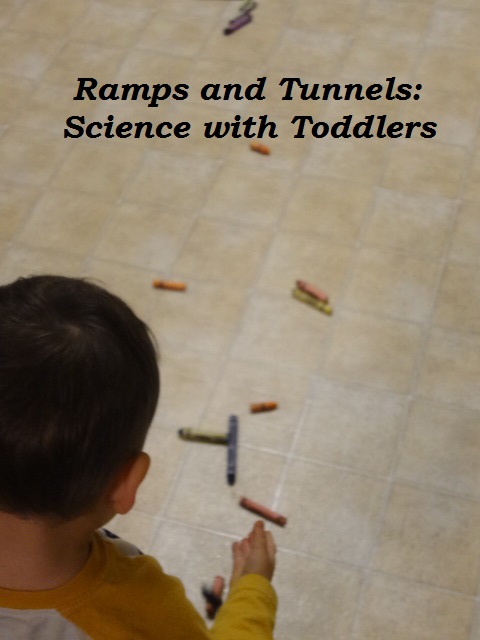
One night, my son started grabbing crayons off his table and running into the kitchen.  He would throw it down on the floor, exclaim with delight and then run in to get another one. I got up and followed him, fully intending to stop him and make him help clean up the mess.

Once I was closer, I could hear what he was saying.  As he threw down each crayon he would yell “ROLL!” as the crayon spun across the floor. I watched as he tested each crayon to see if it would roll too.

If I had just stormed in there and demanded that he stopped, I would have cut off this amazing little moment of scientific discovery.  Now, I still made him help me clean it up when he was done, but it wasn’t hurting anything to let him keep exploring. If I needed access to the kitchen, I could just redirect him to try it on his ramp instead.

That is what I always have to remind myself, is it really a problem or just somewhat inconvenient for me? If it isn’t a problem, I try to let it go forward…but I also feel fine putting a stop to it when it doesn’t work for us anymore.

It may take practice to spot a “science moment” and figure out what to do with it, but you will get there!  Even if you just point it out and use some new language to describe it you are laying the ground work for them to keep loving and discovering science.

Ramps tunnels and does it roll Science with toddlers

Posted in Blog, Early Childhood Education, Museum Fun at Home | Tagged , , , , , , , | 1 Comment

Choose Your Own Museum Adventure

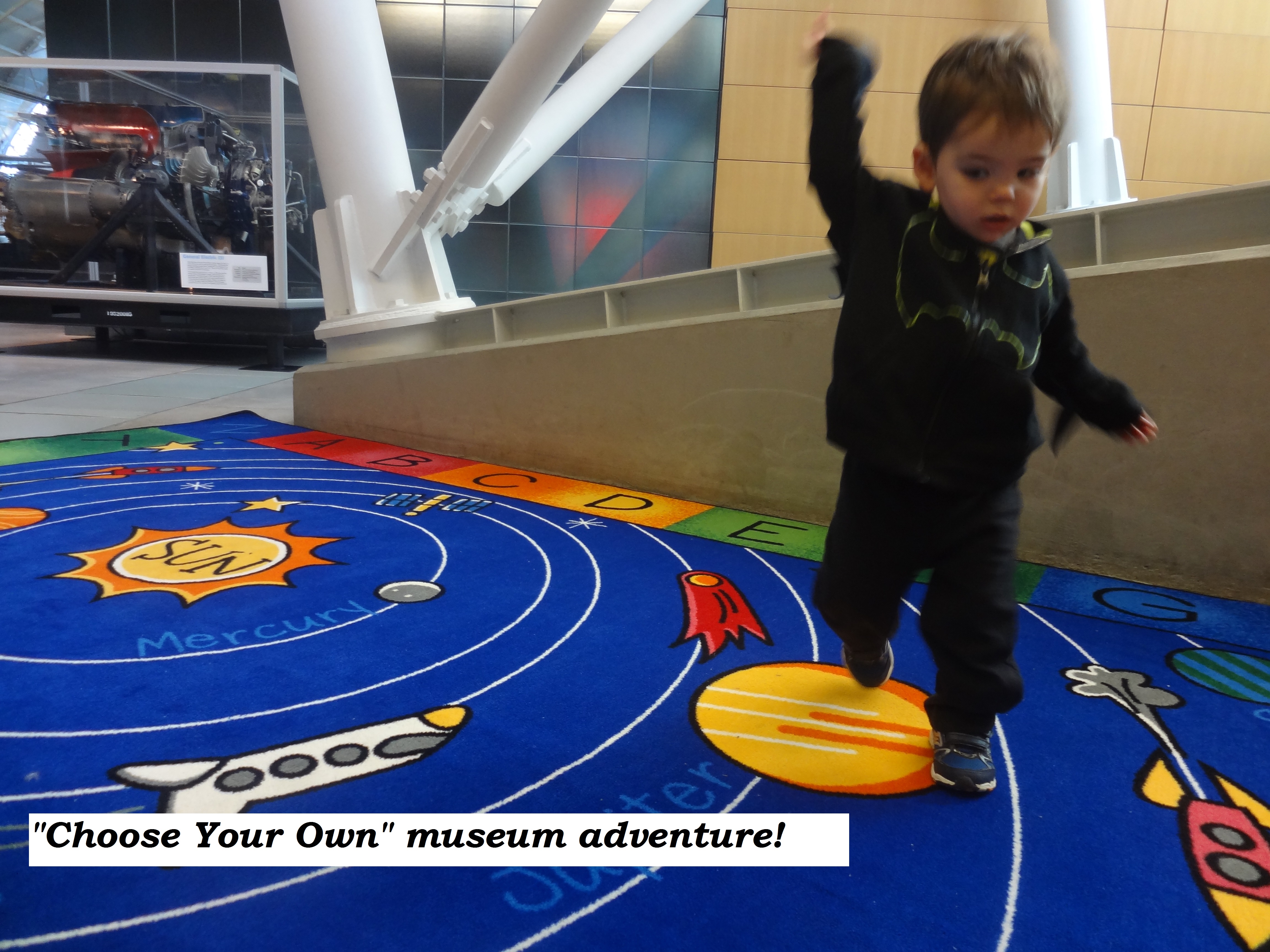
Use your child's interests to pick the perfect museum visit in DC“What museum should I go to?”

That is by far the question I get asked the most frequently…and it is one of my favorites!  I love hearing about the someone’s interests and then trying to match them up with the perfect museum visit.  Since I can’t keep all of you on speed dial, I wrote up a piece for Kid Trips that will let you “choose your own museum adventure.”  Hopefully this will be useful for you either with your own family or when someone comes to visit!

People who visit museums fall into a few distinct categories.  You have the purists, the ones who feel you have to see the museum from front to back and top to bottom.  Often, these are the visitors who are determined that this museum visit will “teach them something important.”  You also have the fans, the ones who revisit a single museum (or sometimes a single piece of art) and just revel in that one experience over and over again.  Finally, there are the fun seekers, the ones who choose a museum because it will be a fun thing to do with the people they are with. 

The amazing thing about being in the D.C. area is that you don’t have to tie yourself down to one type every time.  You can feel a little pity for the visitors doing the “museum march” through every Smithsonian museum; after all you can breeze downtown and just visit the elephant your kid loves and then head home. Since many of the museums are free (or offer good discounts and free days you can take advantage of when you are close) you can spread seeing the whole museum out over a summer, or just go in for the “blockbuster” shows that look like fun.

All of this flexibility also offers you a way to get your kids excited about a museum visit.  Maybe all of you love museums and don’t need any convincing…if so, great!  However, maybe someone in your family has a bad memory of being shuffled through a museum on a family or school trip and just feeling bored.  For them, I want to offer the “Choose Your Own Adventure” model of museum visits….continue reading

Posted in Blog, Cabinet of Curiosities-Updates, Kids in Museums | Tagged , , , , , , | 1 Comment

Eureaka! Science in the Bathtub

Water Science Fun for Babies and ToddlersScience can happen anywhere!  For caregivers with infants and toddlers you learn quickly to grab any chance you have to help your child explore and learn about the world.  In fact, if you look closely at your day you’ll find that you already help facilitate a thousand wonderful moments of learning..you just might not realize it yet!

In our house, some of our best science moments have happened in the bathtub!  I wrote about our experience for the National Association for the Education of Young Children.  Hopefully it will reaffirm the awesome job you are already doing AND help inspire you to continue embracing the learning moments that you already have in your day.

There is a reason that the story of Archimedes shouting “Eureka” in the bathtub persists.  Baths are a great time for thinking and an excellent place for scientific investigation.  At our house, my 1-year-old son’s baths are one of his favorite times to explore and one of my favorite times to support his learning. There is so much to explore and learn with very little equipment, and clean up couldn’t be easier! 

These same explorations  could happen in a pool, bucket, or any body of water with very little adjustment.  This gives the opportunity for children to explore together. Just make sure to keep safety in the forefront.  NEVER leave a child alone during water play…even for a minute. I can’t stress that enough.  Make sure that any toys or containers dry out completely between uses, and sanitize toys if multiple children will use them.  Be sure to monitor toys for mold and replace them when needed.  More complete water safety tips can be found through the Red Cross.

When I think about it, during the course of my son’s bath last night we touched on physics, marine biology, anatomy and acoustics, and he was squeaky clean by the end of it…continue reading

Posted in Blog, Cabinet of Curiosities-Updates, Early Childhood Education, Museum Fun at Home | Tagged , , , , , | 1 Comment

Visiting a Museum From the Comfort of Home

Stuck at home. Visit these great museums online and find interesting projects to do with your kidsSo, it is going to snow tonight.  A lot, according to the weather guys, and there is going to be ice and sleet too.  This is on top of the “a lot” we’ve already had this year.  The commuters aren’t happy, the people waiting in line at the grocery store aren’t happy but the people who REALLY aren’t happy are the parents home for multiple days in a row with bored kiddos.

I can’t make the snow go away, but I can give you some new ideas for what to do at home. If it is too treacherous on the roads to visit a museum…you may just have to make the museum come to you! Luckily, the leaps that technology has taken gives museums a lot of new ways to play with sharing their information and getting you engaged…even when you are sitting on your couch!

This is just a “starter” list, if you or your child has a favorite museum you should see what they have online.

Google Cultural Institute: “Walk” through museums from around the world, curate your own galleries with objects and artwork you love, see online exhibits of historic moments. The resolution is amazing and you can search and sort based on your interests.

Digitized Collections/Online Exhibits: Museums are working hard to bring their collections online.  Often, you can browse through and see individual objects based on theme.  Some museums have even created entire exhibits that only exist online.  Search for your favorite museum and poke around on the website!

If you want somewhere to get started, the list by the (appropriately named) “Museum of Online Museums” should do the trick. Disclaimer: I haven’t personally visited every site they list so I don’t know if all of them are “kid friendly” or not. I also found some neat looking sites just by typing in “kids museum online” so you could try that too.

Some museums don’t exist “in real life” at all and are only online. One of my favorites is”The Museum of Endangered Sounds” (be ready to explain to your tech savvy kid what a “modem” was!)

NGAkids Art Zone: Bring your art-making online! With games, stories, activities and art history information there is a lot for all ages.

Guggenheim- Learning Through Art: If you want to help your budding artist understanding how (and why) artists do what they do, here is an in-depth resource.  The “lesson finder” will help you narrow down ways to teach about looking at and doing art.

Smithsonian’s History Explorer: This database connects you to hundreds of activity ideas for learning about American History.  There are artifacts to explore, book ideas and you can search based on theme, grade, activity type and more!

Smithsonian Kids: This site will let you explore all of the offerings for kids throughout the Smithsonian museums. Everything from the beloved AnimalCams at the Zoo to a virtual Dinosaur Hall!

Pinterest: I know, Pinterest is super overwhelming. May I toot my own horn and suggest you visit the boards I’ve been working on? I’ve got them broken down by activity type (science, math, literacy etc.). The art board especially has a lot of interesting projects related to specific artists, which then leaves you openings to look up more about them!

Hopefully this “starter” list is enough to get you through the storm tomorrow! If you have others to share please leave a comment so other people can discover it too!

Posted in Blog, Kids in Museums, Museum Education, Museum Fun at Home | Tagged , , , , , , , , | Leave a comment