Letters From Camp: Keeping Order Amid Chaos

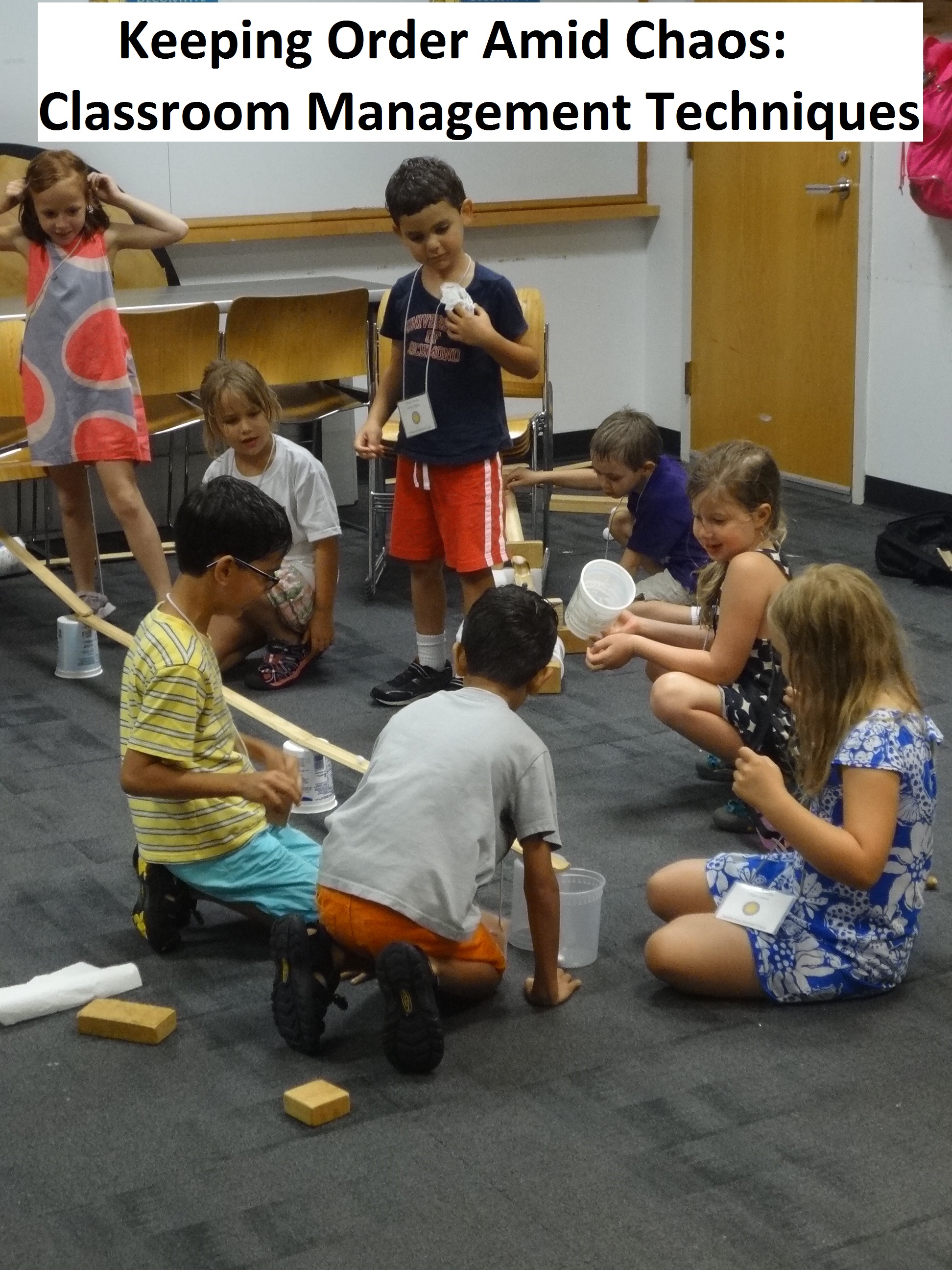
Classroom Management TechniquesSo, as promised in my post last week, I’ve got some reflections that bubbled up after a week of teaching summer camp. Up first…classroom management.

——————————————————————

I knew before I even walked into camp that the first things I had to get back, as dusty and creaky as they might have been, were my classroom management techniques. These are the strategies for keeping kids focused, on task and having fun.

When you are doing a one-off program, ESPECIALLY if the parents are staying with the kids, you can often get away with the bare minimum in terms of discipline strategies. But, if it is longer then one hour, and certainly if you are on your own, you need some tips and tricks fast.

1. The first thing to do is think about your personal pet peeves and boundaries. Do you struggle with chaos? Prefer one voice speaking at a time? Not that you can solve all of them, but knowing what might set you off can help you prepare. Also, what are the expectations at the place you are teaching?

2. Set the ground rules! For older kids (3+) I like having them help me write the rules. It lets us refer back without judgement and they feel more invested in sticking to them. Keep it short and to the point. In fact, if you can keep it to 5 rules or under that would be best!

3. Transitions, any time you are moving from one place or activity to another, is when kids are most likely to lose it. There are whole websites dedicated to transition strategies and it is worth reading up on some of them. Two things you definitely want to plan for are

  • Ways to get attention in a busy classroom. My co-teacher introduced us saying “Ago” and the children responding “Ame” and I have also used “1-2-3, eyes on me” with a response of “1-2 eyes on you!”
  • Songs to fill gap times. It is good to have a whole arsenal of songs to keep kids busy when you are waiting to use the bathroom, a few people are finishing up tasks etc. During camp they LOVED for me to sing any songs that included their names. For a few other ideas you can see this post.

4. Side-stepping a crisis is much better then having to calm everyone down. You can plan for this by looking at your day and figuring out where the “problem areas” might be (hungry kids, a lot of waiting for next activities, transitions).  One thing that is often overlooked is taking time to be thoughtful about how you are grouping kids (whether they walking somewhere or working in small groups). Dynamics can really make or break the day.

5. Build in down time! Every day at lunch we would read two chapters in a book. The kids could sketch, lay down…whatever they wanted. This downtime was critical for ALL of us. The days are busy and full of activity and having a little breather will keep everyone going through the end of the day.

Interesting tip: My co-teacher introduced a “silent signal” of putting your hand on your head if you couldn’t see the book. This saved us a LOT of “I didn’t see it!!!!” when we were reading!

6. Mutual respect in the classroom is key. That looks different for different people. One of my biggest things is that I try to never lie to my students. If I don’t know something, I admit it. If I say something will happen, it either happens or I am up front with them why it couldn’t. It may sound strange and specific, but kids are quick to nice that kind of thing. Whatever form it takes for you, if you show them respect it WILL go a long way to getting some back.

Up next week….working with another teacher.

Posted in Blog, Early Childhood Education | Tagged , , , , | 3 Comments

Letters from Camp: Introduction

Lessons learned from teaching summer camp PART 1I just got back from teaching a week of Smithsonian Associates Summer Camp. Is it wrong that my first reaction was to think “Ow! I forgot how much this hurt?” I haven’t taught full time (outside the home) in two years. When I got back on Monday night my whole body just ached. I’d been on my feet, walking up and down numerous flights of stairs and across unforgiving concrete…all things I normally do with my two year old…but it just felt different. I think the main difference is that I was more keyed up and “on” then I am when it is one-on-one in my own home.

Aching body aside, it was an awesome week. I had a chance to work with a really inspiring co-teacher (check out her book!), the 1st-3rd graders in my class challenged me in (mostly) good ways and we had a chance to design and develop a “Science Sleuths” camp that pulled on all the unique resources of the Smithsonian.

The other great thing about the week is that it forced me to step back and really think about my practice. I had to plan for 17 kids to stay engaged for 6 hours a day. I had to adapt material and classroom management techniques for kids who didn’t know me, but had to work with me for more for a whole week. There were just lots of ways for me to force myself out of my comfort zone.

So, for the next few weeks, I’m going to share the things I learned and thought about. A little bit practical (classroom management techniques) a little bit soapbox (unstructured play) and some fun new tricks for science play with young kids! Enjoy!

Posted in Blog, Cabinet of Curiosities-Updates, Early Childhood Education, Kids in Museums | Tagged , , , , , , | 2 Comments

Pardon Our Dust: This Post is Under Construction

Posts will continue to be updated, I promise!

Just taking a little break while I gear up for Smithsonian Associates Summer Camp  and my new Science of Superheroes workshop at PB&Jack!

We will be back to normal operations soon, thank you for your patience!

Posted in Cabinet of Curiosities-Updates | Leave a comment

It Really is the Little Things

5 simple fixes to make any museum more welcoming for young childrenI love that more museums are incorporating families into their exhibit and program planning. It is really exciting that babies and toddlers are becoming less of an “oddity” to see in the museums.

However, in the excitement of creating new spaces and opportunities for families, it is easy to overlook the smaller, logistical, elements that are actually quite critical for young child-museum-visit-success.

I would encourage all museum professionals to take a look around their space. Whether you are a big institution working actively to bring in families, or a smaller museum doing the best with what you have, there are a few simple “tweaks” that will really make a big difference. In reality, the most exciting and engaging space for young learners might fall apart without these five modest components.

1. Somewhere quiet

Moms who are nursing/bottle feeding want a place quiet and out of the way (please, don’t suggest the bathroom…would you want to eat there?). Parents with children who need some time to calm down also appreciate a quiet area. It doesn’t have to be fancy, even a little used gallery or a side lobby works.

2. Unisex changing options

Having changing tables is a lovely lovely thing…but when they are only in the women’s room it makes it hard on Dads! Also, pretty please have paper towels available near the changing table. Sometimes you need a little extra for clean-up and, in our case, my son is terrified of hand dryers.

3. Stroller Access

My stroller is my mobile house, it has everything we need for the day. If you are able to have stroller access to any part of your museum, make sure that information is available. Add it to your website, mark it on gallery maps, make sure staff know the best routes from A-Z. Luckily, stroller accessible and wheelchair accessible can go hand-in-hand so having the information will help a lot of people.

If you are in a historic building or have some other reason why strollers can’t get around…make that information available too! A bonus is “stroller parking” if you can’t get around with it inside.

4. Tips on kid friendly areas

Is there a great gallery that my kid would love? Is there a space where he can take a snack break? A bathroom that would fit my stroller? Ask staff and volunteers who have kids to draw up a list of tips and tricks for your museum. Make sure this is on the website and something the info desk has access to. Also, make sure your staff is comfortable offering information when they see a family come in. A lot of people will come and ask, but others might be overwhelmed and appreciate a few ideas up front!

5. Staff with an understanding attitude

This is probably the trickiest one, because you can’t just “make” it happen. However, having a staff who is friendly and understanding about the stuff kids do can really make life easier for parents. Yes, I have a lot of stuff and will be slow getting through security. Absolutely, my child might throw a tantrum in the middle of the gallery that I am unable to stop. It comes with the territory and feeling like the staff is “on my side” will really help us all get through it.

At the Garden of Glass in Seattle, we rounded the corner to the “greenhouse” area. A guard saw us (with toddler in tow) and gave a huge smile.  “Here you are!” he said to my son “This is the reward for being so good in the galleries…you can run as much as you like!”  Just knowing up front what was OK for us to do (and that the guard was glad to see kids in the space) made the trip 100% better.

So, how can you make it happen? Build time into front-line staff training to talk about families who visit the gallery. Give staff a safe place to problem solve (and vent) about things that are happening on the floor. Make sure they have resources available so they can direct families to changing tables, areas for eating and places for nursing (let me reiterate..not the bathroom!). Make sure these expectations trickle UP so that ALL staff who might come into contact with visitors know what is expected.

Posted in Blog, Early Childhood Education, Museum Education | Tagged , , , , , , | Leave a comment

Striking Out On Your Own

One thing that I didn’t address in last week’s post about finding a museum job was heading out on your own. Consulting is definitely another route that you can take to work in museums. A lot of places use contractors for everything from education to exhibit design so it is a potential option.

For me, starting a company was the right move. I wanted only part-time work and I had a contracting job lined up already.It has been exciting to get to try new projects, experiment a little with areas I’m not as familiar with and push myself to do some writing and publishing.

That being said even part-time work, without the pressure of being the breadwinner, is not always easy. I do a lot of work early in the morning and late at night. I often feel like I’m doing BOTH of my jobs (Mom and Educator) poorly.  You have to get creative, be flexible with your time and cut yourself a lot of slack. Like that time I had to take a conference call from my car as I sat in the library parking lot (so I could use the public WiFi)…..

If you are thinking about striking out on your own, take into consideration a few of the unexpected things I’ve discovered about working by (and for) yourself.

1. No coworkers

If you have a long term contract, you will be able to have a network of co-workers through that. However, if you are mostly doing solo or short-term work…you are mostly on your own. This can be tiring and isolating and it can be hard to go without someone to bounce ideas off of. Remedies can include professional networks (entrepreneur groups, organizations in your field) and engaging online with others like you.

2. No finance, marketing or human resources department

Setting up my LLC was one of the most daunting things I’ve done. Trying to track tax information, liability insurance, keep up with social media and marketing sometimes leaves me feeling like I’m not doing any of my ACTUAL work…just the logistics work to allow me to do the work.  I have to be very careful that my busy work (necessary as it is) doesn’t take up all my time. Also, finding help for the legal and financial side was critical and the best resource I had was the Women’s Business Center. Even with that I am convinced I’m doing something wrong. (Dear IRS: I really am trying….really!)

3. Finding work can be its own full time job

There is a definite feeling of “hustle hustle” as you try to fill your plate. You have to be completely shameless about cold calling, leveraging contacts and just outright asking if you can help. If you are bidding on federal contracts it is a complicated process all of its own! Of course, as you become established (or…hooray! Land a longer term contract) this eases a bit.

I’ve been lucky that I am not the sole breadwinner for the household, but even I feel like I am not pulling my weight if I am spending on business and childcare expenses without pulling in something. A lot of this is just in my head and sometimes I need to step back and boost my own confidence, everyone has their tactics for organizing their time and getting past low spots…be ready to use them.

Now, this isn’t meant to be a “whoa is me” post, or even one to detract you from trying the consulting thing yourself. I just figured that all of the people who asked how I did it deserved and honest answer!

Posted in Blog, Cabinet of Curiosities-Updates, Museum Education | Tagged , , , , , , | Leave a comment

How Do I Get There…From Here

A few people have reached out to me lately asking about how they “break into” the museum field. I’m incredibly flattered that they are asking me, and I really wish I had the magic formula to give them what they want. Sadly though, there isn’t a secret handshake that transforms you into the perfect candidate.  I do, however, have a few tips I’ve used to help me find a job.

1. Ask people how they got their job

When I was in college, I went to the Museum of Science in Boston. As I watched the electricity show I realized I was more curious about the guy doing the talking then the show itself. Afterwards, I walked up to him and asked “How did you get your job?” Almost ten years later we are still friends!

If you see someone doing something that interests you, ask them about it. Most people love to share their story and you can pick up good tips about internships, classes, volunteer opportunities and more. This leads me in to…..

2. Network…network…network

It can be so daunting and exhausting to network, but it is really what you have to do. When you are traveling someplace new, try to set up an informational interview with someone whose job you admire (see tip #1). Attend professional conferences for the kind of jobs you WANT and talk to the presenters, the exhibitors, the person sitting next to you. Write the author of an article you were impressed with and tell them.

It can be hard to tread the line between being friendly and being bothersome, but staying in touch is one of the best ways to find out about new opportunities.

3. Leverage the Internet

There are listservs, Twitter chats and blogs related to every aspect of the museum field. This is where people go to post jobs, look for project help and talk about what is new and upcoming in the field. Professional networks (like American Alliance of Museums) also have incredible online resources.

Entry level jobs also pop up on Idealist, Craigslist and other job sites that don’t cost a lot of money for the institution to use. Pick a couple of networks and keep up with them. If it is on social media, establish yourself as an informed contributor. Once it becomes habit you will be ready to jump on the job postings as they come up.

4. Go the unpaid route

Volunteering is the #1 best way to get your foot in a door. Whether you do a regular volunteer gig, help out on family days or special events or contribute in some other way, that is how you learn the culture and people.

If you are able to take classes in the field, you will not only have a chance to intern but also meet people through the classes that can connect you with job opportunities.  You will just have to use tip 1 and 2 to make it happen!

5. Entry level is OK

Whether you start out as a gallery docent, at the admission desk or giving tours…you are now in the door of the museum. Yes, it may not be exactly what you wanted (or even full time) but there you are.

My first job was as a weekend tour docent.  I tried to do my job well, volunteer for things more in line with what I wanted and make sure they knew I was serious about helping out. When the educator left, they thought of me to help fill the gap.

There are a lot of great entry level positions that will help you get experience. As you get to know the institution you can volunteer to help in other areas and take advantage of professional development and other opportunities.

I am not guaranteeing that if you follow my tips you will land your dream museum job. It will, however, give you a chance to make connections, figure out where the jobs are and how to position yourself to be best suited for them.  Also, you will have a better sense of the field and where you fit in it overall.  Best of luck! Let me know if there is anything I can do to help.

Posted in Blog, Cabinet of Curiosities-Updates, Museum Education | Tagged , , , , , | Leave a comment

Keeping the Conversation Going: Early Childhood Programs

After the conference keeping the conversation about early learning in museums goingI had a little lag in my posts…I’m sorry about that! I’ve really tried to keep up a once-a-week schedule, but these past few weeks have been a little out of the ordinary! The biggest excitement was when we packed up the toddler and headed out west to Seattle for the annual conference of the American Alliance of Museums .

Meredith Downing (currently at Stanford University), Megan Smith of the National Museum of American History, Claudia Ocello (Museum Partners Consulting LLC) and I led discussion groups for museum professionals interested in early childhood programs. Whether they had established programs that needed tweaking, or were just in the first planning stages, we tried to give them a place to talk together about their questions and concerns.

The packed session confirmed my gut feeling…people want young children in the museum and are looking for how to get them there, what to do with them and why it is a good idea.

Conferences always leave me jazzed for what can come next. The fact that there was so much interest in early learning in museums, and so many people looking to connect with each other and find resources got me thinking about how to keep the conversation going.

I realized, the first step is we need to FIND each other. I met a lot of people at the conference who are doing great work with young children…so why was I just hearing about them now?

Rather then leave it to chance encounters at museums…I will go with the direct approach. I want to hear from you.  Are you interested in early learning in museums? Do you have a stellar program at your institution right now for the 5 and under crowd?  Please, email me!  Tell me a bit about yourself and also, how you like to connect with other museum professionals.  Do you read blogs? Tweet? Use listservs?

Getting a sense of who is out there and how they like to connect will give us more options for bringing the conversation together…which can only do good things for all of our institutions and all of us as professionals!

I can’t wait to hear from you!  And please, spread the word to others you know who are interested and want to be involved.  I can be found here on my website, on Facebook or Twitter and I even respond to email (cabinetofcuriositiesva@gmail.com).


Posted in Blog, Cabinet of Curiosities-Updates, Early Childhood Education, Kids in Museums, Museum Education | Tagged , , , , | Leave a comment

Surviving Conferences: Ten Tried-and-True Tps

Ten tips for surviving, and enjoying, your conference experienceI just got back from the American Alliance of Museums Conference.  It was awesome, it was exhausting, it was….a conference.  Somehow they always manage to be thrilling and overwhelming all at the same time!

You will hear more about why I was there and what I want to do with it NEXT week (I know, the suspense right?).  For right now, I want to give you my ten tips for conference survival! Hopefully they help as you head off to your own professional conferences!

1. Wear comfortable shoes

2. Stay hydrated and fed

3. Make a plan but take it one day at a time so you don’t feel overwhelmed

4. Take breaks, it is ok to skip one session and go see your host city

5. Share outlets

6. Talk to strangers!

7. Bring business cards, even if you are a student or under-employed! Write notes of how you met people on the back of the cards you collect. Pen and paper is also always a good idea

8. Make plans to hang out with people you know. Constantly networking can get very tiring and lonely

9. Make plans to meet “in real life” the people you usually just connect with online

10. Go to sessions for the job you WANT as well as the one you HAVE.                                     **I heard this one on Twitter, but can’t find who I should attribute it to!**


Posted in Blog, Cabinet of Curiosities-Updates, Museum Education | Tagged , , | 3 Comments

Don’t Forget the Parents

When planning programs for kids...don't forget the parents!

When I am planning a program for a library, school or other community group…the focus is on the kids.  After all, that is my target audience, they are the ones who will be sitting in front of me. So, when I’m thinking about the content, the visuals and the activities I am thinking about what will best be suited for the age I’m teaching.

That is a good and necessary thing, but I was reminded that I shouldn’t forget the parents.  Too often, I think of the adults in the room as pretty much glorified chauffeurs.  They find the activity, get the kid there and then check out.  And it is true, there are many parents who are glad to sit back and not be 100% in charge for a while (Hey, I have a toddler at home, so I don’t blame them one bit!)

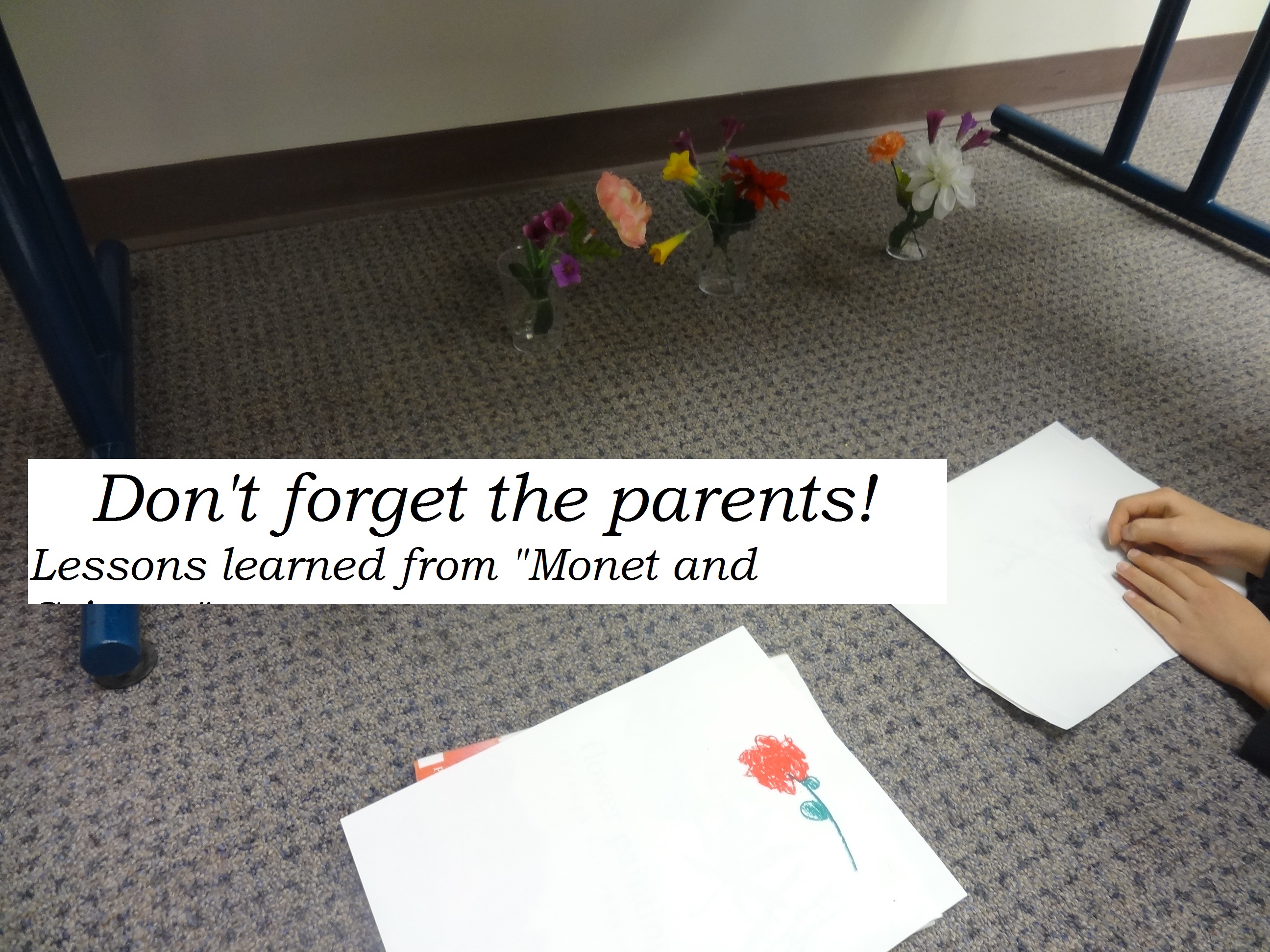
But, that isn’t always the case.  At Herndon Library I taught a program on Monet the “artist and scientist.”  The kids explored how you can “spot” a Monet and we dove into his interest in light and how it affected his paintings.  We also looked at researchers using clues from the sun position and tide in his paintings to try and time stamp them (read about that here).

To finish off the day, they had a chance to create a still life and try painting it under different light conditions. As they worked, I walked around to talk to them, answer questions and generally get a sense for what they were thinking about the day.

Every few feet though, I was stopped by a parent. Some of them were curious about how to get their kids more interested in art.  Some wanted to hear more about strategies for taking kids to museums (I had mentioned that several of the Monet’s we were looking at were in the National Gallery of Art). A few were genuinely curious about the topic themselves and wanted to hear more about Monet’s techniques and inspirations.

Part of me worried a little that I was ignoring the kids, who I felt were my “audience.”  But I realized that I needed to relax.  It is completely critical to have the kids fall in love with art and museums if you want them to engage with them.  It is equally critical to have the parents be interested and understand the value it has for their kids.  After all, they ARE the chauffeurs and will be more likely to bring their kids if they enjoy it themselves and see the value in it.

How to best engage the parents will differ from program to program.  Sometimes it will be casual conversations, like we had about Monet.  Other times a more formal hand-out might be the ticket. No matter what, I won’t forget to prepare something for my other important audience again!

Posted in Cabinet of Curiosities-Updates, Early Childhood Education, Museum Education, Museum Fun at Home, Uncategorized | Tagged , , , , , , , | Leave a comment

3 Simple Rules

3 simple rules for helping kids and adults follow museum rules and enjoy their visit

Rules are tricky for little kids.  It’s not that they set out to be “anti-establishment,” in fact many experts tout how much they crave guidelines, there is just a LOT to remember and SO many temptations!

Museums easily fall into that list of “a lot to remember” and “interesting temptations” with so much stuff that looks so fun to touch.  Admit it, you’ve seen as many adults behaving badly as you have young kids! To try and help out, well meaning museum professionals put together rules.  These rules make sense, they are there to protect the objects and make sure everyone can enjoy the space.

Unfortunately, that isn’t how they always come off.  For people who are already nervous about visiting the museum it just feels like a long list of ways they are going to “mess up” and “get in trouble.”  For parents with young kids, it is a list that goes against all of the innate tendencies of kids (touching things, getting excited, moving at high velocities).

So, what can you do? I think there is a middle ground if you think back through your rules through the eyes of the visitor.

1. The first step is to explain to people WHY the rules exist.  It may make perfect sense to you, but it is easy to forget you already have “insider knowledge.” Talk about (or better yet show) how touching can ruin artifacts. Explain why you want them to walk, or not take pictures. Kids will get it if you take the time to show them.  Once they “sign on” they will be your biggest advocates (and keep their parents in line!)

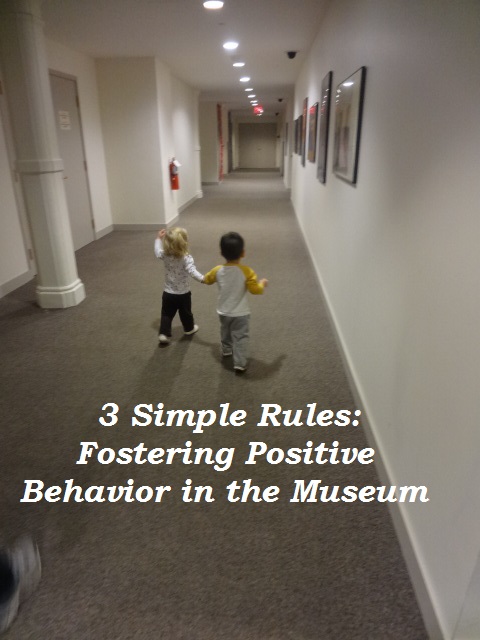
2. Trim down your rules for your littlest visitors.  Yes, all of your rules serve a purpose…but if there are too many of them kids aren’t going to be able to keep track of them. When I taught, by the time kids turned four we expected them to be able to follow three-step directions.  So, keep your rules to three. At the Smithsonian Early Enrichment Center, we called these our “Museum Manners” and they were simply:

  • Catch a Bubble: For the kids that meant pretending to hold a bubble in their mouth.  In non-cutesy terms it means to keep your voice low
  • Keep Your Hands in Your Pockets or On Your Stomach: To help avoid the need to touch things, the kids would put their hands either in their pockets or on their stomach (if they didn’t have pockets)
  • Calm Walking Feet: Pretty self-explanatory.  The playground was for running, the museum was for walking.

Simple right? These rules cut right to the chase and helped kids meet the most important expectations of the museum. The best part was, because they had a name (Museum Manners) you could reference them and not have to chastise a child personally. Very nice to say “Oh!  Are those your Museum Manners?” rather then “No Running!” Based on the expectations of your space you can tweak the wording and even replace a rule with one of your own.

Starting each program with a review of your 3 rules, having them printed at your info desk and training your staff to use them will help them become a part of your museum’s culture. Bonus, it is easy for parents to adopt and use on their own and you can give the outline to teacher’s in advance for them to practice before coming.

3. Reassure people (kids and adults). Tell them you are glad they are excited to be there. Smile when a kid shouts out in excitement, act sympathetic if a baby is crying.  Get them on your side by enlisting their help in protecting the objects and following the rules.  Compare your space to a library and remind them they probably know what to expect there and it is very similar here. Basically, make sure they know you are glad they are there!  I’ve been to a few museums where I walked away feeling like the staff and volunteers really wished the visitors wouldn’t come.  This is not the feeling you want to give!

Another important thing, make sure your staff knows that children are people too and that they are welcome in your space.  This isn’t just for your front-line staff.  EVERYONE who might come in contact with a visitor should know what is expected and how to help guide them. It does you no favors if you are welcoming to adult visitors but give an icy reception to children. They take notice, and won’t give your space respect.  Their parents take notice, and won’t come back.

Posted in Blog, Early Childhood Education, Kids in Museums, Museum Education | Tagged , , , , , | 2 Comments